Replication Types
NAKIVO Backup & Replication allows you to replicate virtual machines and Amazon EC2 instances.
VM Replication
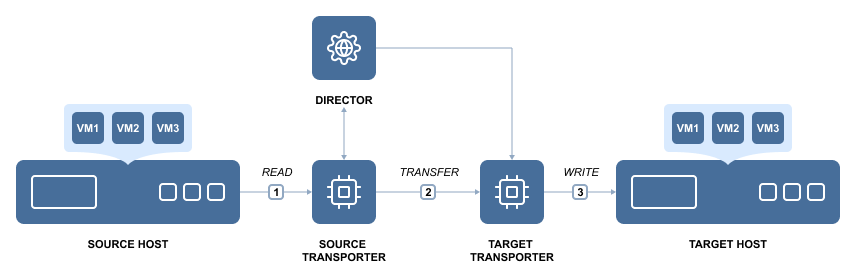
A VM replica is an exact copy of an entire VMware or Hyper-V VM created on a target host. VM replication supports business continuity by allowing you to immediately power on a replica if the primary VM becomes unavailable. Replicas are stored on target hosts in a powered-off state and therefore do not consume compute resources until they are needed. If a source VM fails, you can power on the replica directly, without using NAKIVO Backup & Replication.
NAKIVO Backup & Replication allows you to add individual VMs or entire VMware containers—such as resource pools, folders, hosts, or clusters—to a replication job. Any new VMs that are created in or moved to a protected container are automatically included in the replication job. For each replica, you can store up to 30 recovery points, allowing you to revert to a previous working state even if a replication was performed after an error occurred on the source VM.
Amazon EC2 Replication
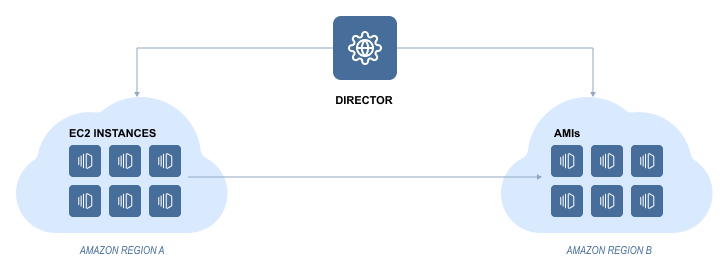
Amazon EC2 replication creates identical copies of Amazon EC2 instances as Amazon Machine Images (AMIs), ensuring business continuity if primary instances or an entire region become unavailable. NAKIVO Backup & Replication allows you to replicate Amazon EC2 instances either within the same region or across regions.
For same-region replication, NAKIVO Backup & Replication initiates the creation of snapshots of the selected source volumes and then creates an AMI using the source instance configuration and the generated snapshots. For cross-region replication, the solution first creates snapshots of the selected source volumes in the source region, copies those snapshots to the target region, and then creates an AMI using the source instance configuration and the copied snapshots. After the process is complete, NAKIVO Backup & Replication removes the snapshots from the source region.
To learn how to create VMware, Hyper-V, and Amazon EC replication jobs, refer to the corresponding topics in Replication.